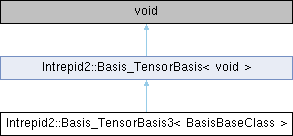
Public Types | |
| using | BasisPtr = Teuchos::RCP<BasisBase> |
| Public Types inherited from Intrepid2::Basis_TensorBasis< void > | |
| using | BasisBase |
| using | BasisPtr |
| using | DeviceType |
| using | ExecutionSpace |
| using | OutputValueType |
| using | PointValueType |
| using | OrdinalTypeArray1DHost |
| using | OrdinalTypeArray2DHost |
| using | OrdinalTypeArrayStride1DHost |
| using | OutputViewType |
| using | PointViewType |
| using | TensorBasis |
Public Member Functions | |
| Basis_TensorBasis3 (BasisPtr basis1, BasisPtr basis2, BasisPtr basis3, const bool useShardsCellTopologyAndTags=false) | |
| virtual OperatorTensorDecomposition | getOperatorDecomposition (const EOperator operatorType) const override |
| Returns a full decomposition of the specified operator. (Full meaning that all TensorBasis components are expanded into their non-TensorBasis components.). | |
| virtual void | getValues (OutputViewType outputValues, const EOperator operatorType, const PointViewType inputPoints12, const PointViewType inputPoints3, bool tensorPoints) const override |
| Evaluation of a tensor FEM basis on a reference cell. | |
| virtual void | getValues (OutputViewType outputValues, const EOperator operatorType, const PointViewType inputPoints1, const PointViewType inputPoints2, const PointViewType inputPoints3, bool tensorPoints) const =0 |
| Evaluation of a tensor FEM basis on a reference cell; subclasses should override this. | |
| void | getValues (OutputViewType outputValues, const PointViewType inputPoints1, const EOperator operatorType1, const PointViewType inputPoints2, const EOperator operatorType2, const PointViewType inputPoints3, const EOperator operatorType3, bool tensorPoints, double weight=1.0) const |
| Evaluation of a tensor FEM basis on a reference cell; subclasses should override this. | |
| virtual void | getDofCoeffs (typename BasisBase::ScalarViewType dofCoeffs) const override |
| Fills in coefficients of degrees of freedom on the reference cell. | |
| virtual HostBasisPtr< OutputValueType, PointValueType > | getHostBasis () const override |
| Creates and returns a Basis object whose DeviceType template argument is Kokkos::HostSpace::device_type, but is otherwise identical to this. | |
| virtual void | getValues (BasisValues< OutputValueType, DeviceType > outputValues, const TensorPoints< PointValueType, DeviceType > inputPoints, const EOperator operatorType=OPERATOR_VALUE) const override |
| Evaluation of a FEM basis on a reference cell, using point and output value containers that allow preservation of tensor-product structure. | |
| void | getValues (OutputViewType outputValues, const PointViewType inputPoints, const EOperator operatorType=OPERATOR_VALUE) const override |
| Evaluation of a FEM basis on a reference cell. | |
| virtual void | getValues (OutputViewType outputValues, const EOperator operatorType, const PointViewType inputPoints1, const PointViewType inputPoints2, bool tensorPoints) const |
| Evaluation of a tensor FEM basis on a reference cell; subclasses should override this. | |
| void | getValues (OutputViewType outputValues, const PointViewType inputPoints1, const EOperator operatorType1, const PointViewType inputPoints2, const EOperator operatorType2, bool tensorPoints, double weight=1.0) const |
| Evaluation of a tensor FEM basis on a reference cell. | |
| Public Member Functions inherited from Intrepid2::Basis_TensorBasis< void > | |
| Basis_TensorBasis (BasisPtr basis1, BasisPtr basis2, EFunctionSpace functionSpace=FUNCTION_SPACE_MAX, const bool useShardsCellTopologyAndTags=false) | |
| Constructor. | |
| void | setShardsTopology () |
| ordinal_type | getCompositeSubcellOrdinal (const ordinal_type subcellDim1, const ordinal_type subcellOrd1, const ordinal_type subcellDim2, const ordinal_type subcellOrd2) const |
| void | fillDofTag (const ordinal_type dofOrd, OrdinalTypeArray2DHost tag, const ordinal_type row) const |
| void | setTensorProductTags () |
| virtual void | requireTags () const override |
| materializes the dense tag tables on first request (thread-safe) | |
| void | requireCompositeSubcellMap () const |
| builds compositeSubcellToComponents_ (once; thread-safe) | |
| virtual ordinal_type | getDofCount (const ordinal_type subcDim, const ordinal_type subcOrd) const override |
| DoF count for the specified subcell, computed from the component bases (without building dense tag tables). | |
| virtual ordinal_type | getDofOrdinal (const ordinal_type subcDim, const ordinal_type subcOrd, const ordinal_type subcDofOrd) const override |
| DoF tag to ordinal lookup, computed from the component bases (without building dense tag tables). | |
| virtual const OrdinalTypeArray2DHost | getAllDofTags () const override |
| void | setShardsTopologyAndTags () |
| virtual int | getNumTensorialExtrusions () const override |
| ordinal_type | getTensorDkEnumeration (ordinal_type dkEnum1, ordinal_type operatorOrder1, ordinal_type dkEnum2, ordinal_type operatorOrder2) const |
| Given "Dk" enumeration indices for the component bases, returns a Dk enumeration index for the composite basis. | |
| virtual OperatorTensorDecomposition | getSimpleOperatorDecomposition (const EOperator &operatorType) const |
| Returns a simple decomposition of the specified operator: what operator(s) should be applied to basis1, and what operator(s) to basis2. A one-element OperatorTensorDecomposition corresponds to a single TensorData entry; a multiple-element OperatorTensorDecomposition corresponds to a VectorData object with axialComponents = false. | |
| virtual BasisValues< OutputValueType, DeviceType > | allocateBasisValues (TensorPoints< PointValueType, DeviceType > points, const EOperator operatorType=OPERATOR_VALUE) const override |
| Allocate BasisValues container suitable for passing to the getValues() variant that takes a TensorPoints container as argument. | |
| void | getComponentPoints (const PointViewType inputPoints, const bool attemptTensorDecomposition, PointViewType &inputPoints1, PointViewType &inputPoints2, bool &tensorDecompositionSucceeded) const |
| Method to extract component points from composite points. | |
| virtual void | getDofCoords (typename BasisBase::ScalarViewType dofCoords) const override |
| Fills in spatial locations (coordinates) of degrees of freedom (nodes) on the reference cell. | |
| virtual const char * | getName () const override |
| Returns basis name. | |
| std::vector< BasisPtr > | getTensorBasisComponents () const |
| virtual void | getValues (BasisValues< OutputValueType, DeviceType > outputValues, const TensorPoints< PointValueType, DeviceType > inputPoints, const EOperator operatorType=OPERATOR_VALUE) const override |
| Evaluation of a FEM basis on a reference cell, using point and output value containers that allow preservation of tensor-product structure. | |
Protected Attributes | |
| BasisPtr | basis1_ |
| BasisPtr | basis2_ |
| BasisPtr | basis3_ |
| Protected Attributes inherited from Intrepid2::Basis_TensorBasis< void > | |
| BasisPtr | basis1_ |
| BasisPtr | basis2_ |
| std::vector< BasisPtr > | tensorComponents_ |
| std::string | name_ |
| int | numTensorialExtrusions_ |
| bool | useShardsCellTopologyAndTags_ |
| std::map< std::pair< ordinal_type, ordinal_type >, std::array< ordinal_type, 4 > > | compositeSubcellToComponents_ |
| composite (subcell dim, subcell ordinal) -> component subcells (d1, s1, d2, s2); built lazily by getDofCount()/getDofOrdinal() | |
| bool | compositeSubcellMapBuilt_ |
| std::shared_ptr< std::recursive_mutex > | lazyInitializationMutex_ |
| Guards lazy initialization in const methods (of the tag tables and of compositeSubcellToComponents_), so that TensorBasis objects shared between host threads may be queried concurrently. Held by pointer so that TensorBasis remains copyable. (Concurrent queries also require that Kokkos be built with real atomics, since the tag queries return reference-counted Views; Trilinos enables Kokkos_ENABLE_ATOMICS_BYPASS by default when Serial is the only Kokkos backend.) This lives here rather than in Basis because Basis must remain copyable on device; see Basis::requireTags(). The lazy initialization must not dispatch Kokkos kernels, so that it may run inside an OpenMP parallel region. | |
Private Types | |
| using | BasisBase = BasisBaseClass |
| using | TensorBasis = Basis_TensorBasis<BasisBase> |
Detailed Description
class Intrepid2::Basis_TensorBasis3< BasisBaseClass >
Definition at line 2223 of file Intrepid2_TensorBasis.hpp.
Member Typedef Documentation
◆ BasisBase
|
private |
Definition at line 2226 of file Intrepid2_TensorBasis.hpp.
◆ BasisPtr
| using Intrepid2::Basis_TensorBasis3< BasisBaseClass >::BasisPtr = Teuchos::RCP<BasisBase> |
Definition at line 2238 of file Intrepid2_TensorBasis.hpp.
◆ TensorBasis
|
private |
Definition at line 2227 of file Intrepid2_TensorBasis.hpp.
Constructor & Destructor Documentation
◆ Basis_TensorBasis3()
|
inline |
Definition at line 2244 of file Intrepid2_TensorBasis.hpp.
Member Function Documentation
◆ getDofCoeffs()
|
inlineoverridevirtual |
Fills in coefficients of degrees of freedom on the reference cell.
- Parameters
-
[out] dofCoeffs - the container into which to place the degrees of freedom.
dofCoeffs is a rank 1 with dimension equal to the cardinality of the basis.
Note that getDofCoeffs() is not supported by all bases; in particular, hierarchical bases do not generally support this.
Reimplemented from Intrepid2::Basis_TensorBasis< void >.
Definition at line 2484 of file Intrepid2_TensorBasis.hpp.
◆ getHostBasis()
|
inlineoverridevirtual |
Creates and returns a Basis object whose DeviceType template argument is Kokkos::HostSpace::device_type, but is otherwise identical to this.
- Returns
- Pointer to the new Basis object.
Reimplemented from Intrepid2::Basis_TensorBasis< void >.
Definition at line 2520 of file Intrepid2_TensorBasis.hpp.
◆ getOperatorDecomposition()
|
inlineoverridevirtual |
Returns a full decomposition of the specified operator. (Full meaning that all TensorBasis components are expanded into their non-TensorBasis components.).
The outer container has a length that corresponds to the number of vector components in output; the inner container has one entry per basis component.
A one-element outer container corresponds to a single TensorData entry; a multiple-element outer container corresponds to a VectorData object with axialComponents = false.
Reimplemented from Intrepid2::Basis_TensorBasis< void >.
Definition at line 2260 of file Intrepid2_TensorBasis.hpp.
◆ getValues() [1/7]
|
inlineoverride |
Evaluation of a FEM basis on a reference cell, using point and output value containers that allow preservation of tensor-product structure.
Returns values of operatorType acting on FEM basis functions for a set of points in the reference cell for which the basis is defined.
- Parameters
-
outputValues [out] - variable rank array with the basis values. Should be allocated using Basis::allocateBasisValues(). inputPoints [in] - rank-2 array (P,D) with the evaluation points. This should be allocated using Cubature::allocateCubaturePoints() and filled using Cubature::getCubature(). operatorType [in] - the operator acting on the basis function
This is the preferred getValues() method for TensorBasis and DirectSumBasis and their subclasses. It allows a reduced memory footprint and optimized integration, etc.
Definition at line 1557 of file Intrepid2_TensorBasis.hpp.
◆ getValues() [2/7]
|
inline |
Evaluation of a tensor FEM basis on a reference cell; subclasses should override this.
Returns values of operatorType acting on FEM basis functions for a set of points in the reference cell for which the basis is defined.
- Parameters
-
outputValues [out] - variable rank array with the basis values operatorType [in] - the operator acting on the basis functions inputPoints1 [in] - rank-2 array (P1,D1) with the evaluation points for basis1 inputPoints2 [in] - rank-2 array (P2,D2) with the evaluation points for basis2 tensorPoints [in] - whether the points should be interpreted as tensor components of the evaluation points, or in a one-to-one correspondence
Subclasses should override this method; this gives them an opportunity to specify how operatorType should be decomposed into operators on the component bases.
If tensorPoints is true, then the points dimension of outputValues should be (P1*P2). If tensorPoints is false, then P1 should equal P2, and these should match the points dimension of outputValues.
There are three variants of getValues:
- The three-argument version defined by Intrepid2::Basis. TensorBasis provides an implementation of this, which calls the five-argument version (this one).
- The five-argument version (this method), which provides separate point sets for the component bases, and must be specified by subclasses. Typical implementations call the seven-argument version.
- The seven-argument version (below), implemented by TensorBasis, which provides separate point sets and operators for the component bases, as well as an optional weight.
The intent is that subclasses implement this five-argument version; in that implementation, they need to do little else than call the seven-argument version below.
Note that the three-argument implementation handles the OPERATOR_Dn operators directly; that is, subclasses can omit any consideration of OPERATOR_Dn operators in their implementation of the five-argument version.
Definition at line 1854 of file Intrepid2_TensorBasis.hpp.
◆ getValues() [3/7]
|
pure virtual |
Evaluation of a tensor FEM basis on a reference cell; subclasses should override this.
Returns values of operatorType acting on FEM basis functions for a set of points in the reference cell for which the basis is defined.
- Parameters
-
outputValues [out] - variable rank array with the basis values operatorType [in] - the operator acting on the basis functions inputPoints1 [in] - rank-2 array (P1,D1) with the evaluation points for basis1 inputPoints1 [in] - rank-2 array (P2,D2) with the evaluation points for basis2 inputPoints3 [in] - rank-2 array (P3,D3) with the evaluation points for basis3 tensorPoints [in] - whether the points should be interpreted as tensor components of the evaluation points, or in a one-to-one correspondence
Subclasses should override this method; this gives them an opportunity to specify how operatorType should be decomposed into operators on the component bases.
If tensorPoints is true, then the points dimension of outputValues should be (P1*P2*P3). If tensorPoints is false, then P1 should equal P2 and P2 should equal P3, and these should match the points dimension of outputValues.
There are four variants of getValues:
- The three-argument version defined by Intrepid2::Basis. TensorBasis provides an implementation of this, which calls the five-argument version (this one).
- The five-argument version (above), which provides partially separated point sets for the component bases. TensorBasis3 provides an implementation of this, which calls the six-argument version.
- The six-argument version (this method), which fully separates the point sets for the component bases. Subclasses should implement this; they essentially specify the decomposition of the operator.
- The nine-argument version (below), implemented by TensorBasis3, which provides separate point sets and operators for the component bases, as well as an optional weight.
The intent is that subclasses implement this six-argument version; in that implementation, they need to do little else than call the nine-argument version below.
Note that the three-argument implementation handles the OPERATOR_Dn operators directly; that is, subclasses can omit any consideration of OPERATOR_Dn operators in their implementation of the five-argument version.
◆ getValues() [4/7]
|
inlineoverridevirtual |
Evaluation of a tensor FEM basis on a reference cell.
Returns values of operatorType acting on FEM basis functions for a set of points in the reference cell for which the basis is defined.
- Parameters
-
outputValues [out] - variable rank array with the basis values operatorType [in] - the operator acting on the basis functions inputPoints12 [in] - rank-2 array (P12,D12) with the evaluation points for basis12 inputPoints3 [in] - rank-2 array (P3,D3) with the evaluation points for basis3 tensorPoints [in] - whether the points should be interpreted as tensor components of the evaluation points, or in a one-to-one correspondence
If tensorPoints is true, then the points dimension of outputValues should be (P12*P3). If tensorPoints is false, then P12 should equal P3, and these should match the points dimension of outputValues.
There are four variants of getValues:
- The three-argument version defined by Intrepid2::Basis. TensorBasis provides an implementation of this, which calls the five-argument version (this one).
- The five-argument version (this method), which provides partially separated point sets for the component bases. TensorBasis3 provides an implementation of this, which calls the six-argument version.
- The six-argument version, which fully separates the point sets for the component bases. Subclasses should implement this; they essentially specify the decomposition of the operator.
- The nine-argument version (below), implemented by TensorBasis3, which provides separate point sets and operators for the component bases, as well as an optional weight.
The intent is that subclasses implement the six-argument version; in that implementation, they need to do little else than call the nine-argument version below.
Note that the three-argument implementation handles the OPERATOR_Dn operators directly; that is, subclasses can omit any consideration of OPERATOR_Dn operators in their implementation of the six-argument version.
Definition at line 2293 of file Intrepid2_TensorBasis.hpp.
Referenced by Intrepid2::Basis_TensorBasis3< typename HGRAD_LINE::BasisBase >::getValues().
◆ getValues() [5/7]
|
inlineoverride |
Evaluation of a FEM basis on a reference cell.
Returns values of operatorType acting on FEM basis functions for a set of points in the reference cell for which the basis is defined.
- Parameters
-
outputValues [out] - variable rank array with the basis values inputPoints [in] - rank-2 array (P,D) with the evaluation points operatorType [in] - the operator acting on the basis functions
- Remarks
- For rank and dimension specifications of the output array see Section MD array template arguments for basis methods. Dimensions of ArrayScalar arguments are checked at runtime if HAVE_INTREPID2_DEBUG is defined.
- A FEM basis spans a COMPLETE or INCOMPLETE polynomial space on the reference cell which is a smooth function space. Thus, all operator types that are meaningful for the approximated function space are admissible. When the order of the operator exceeds the degree of the basis, the output array is filled with the appropriate number of zeros.
Definition at line 1712 of file Intrepid2_TensorBasis.hpp.
◆ getValues() [6/7]
|
inline |
Evaluation of a tensor FEM basis on a reference cell.
Returns values of operatorType acting on FEM basis functions for a set of points in the reference cell for which the basis is defined.
- Parameters
-
outputValues [out] - variable rank array with the basis values inputPoints1 [in] - rank-2 array (P1,D1) with the evaluation points for basis1 operatorType1 [in] - the operator acting on basis1 inputPoints2 [in] - rank-2 array (P2,D2) with the evaluation points for basis2 operatorType2 [in] - the operator acting on basis2 tensorPoints [in] - whether the points should be interpreted as tensor components of the evaluation points, or in a one-to-one correspondence weight [in] - optional weight (typically 1.0 or -1.0)
If tensorPoints is true, then the points dimension of outputValues should be (P1*P2). If tensorPoints is false, then P1 should equal P2, and these should match the points dimension of outputValues.
There are three variants of getValues:
- The three-argument version defined by Intrepid2::Basis. TensorBasis provides an implementation of this, which calls the five-argument version (this one).
- The five-argument version (above), which provides separate point sets for the component bases, and must be specified by subclasses. Typical implementations call the seven-argument version.
- The seven-argument version (this method), implemented by TensorBasis, which provides separate point sets and operators for the component bases, as well as an optional weight.
Subclasses should override the five-argument version above; in their implementation, they need to do little else than call this seven-argument version.
Definition at line 1884 of file Intrepid2_TensorBasis.hpp.
◆ getValues() [7/7]
|
inline |
Evaluation of a tensor FEM basis on a reference cell; subclasses should override this.
Returns values of operatorType acting on FEM basis functions for a set of points in the reference cell for which the basis is defined.
- Parameters
-
outputValues [out] - variable rank array with the basis values inputPoints1 [in] - rank-2 array (P1,D1) with the evaluation points for basis1 operatorType1 [in] - the operator acting on basis1 inputPoints2 [in] - rank-2 array (P2,D2) with the evaluation points for basis2 operatorType2 [in] - the operator acting on basis2 inputPoints3 [in] - rank-2 array (P3,D3) with the evaluation points for basis3 operatorType3 [in] - the operator acting on basis3 tensorPoints [in] - whether the points should be interpreted as tensor components of the evaluation points, or in a one-to-one correspondence
If tensorPoints is true, then the points dimension of outputValues should be (P1*P2*P3). If tensorPoints is false, then P1 should equal P2 and P2 should equal P3, and these should match the points dimension of outputValues.
There are four variants of getValues:
- The three-argument version defined by Intrepid2::Basis. TensorBasis provides an implementation of this, which calls the five-argument version (this one).
- The five-argument version (above), which provides partially separated point sets for the component bases. TensorBasis3 provides an implementation of this, which calls the six-argument version.
- The six-argument version (this method), which fully separates the point sets for the component bases. Subclasses should implement this; they essentially specify the decomposition of the operator.
- The nine-argument version (below), implemented by TensorBasis3, which provides separate point sets and operators for the component bases, as well as an optional weight.
The intent is that subclasses implement this six-argument version; in that implementation, they need to do little else than call the nine-argument version below.
Note that the three-argument implementation handles the OPERATOR_Dn operators directly; that is, subclasses can omit any consideration of OPERATOR_Dn operators in their implementation of the five-argument version.
Definition at line 2380 of file Intrepid2_TensorBasis.hpp.
Member Data Documentation
◆ basis1_
|
protected |
Definition at line 2240 of file Intrepid2_TensorBasis.hpp.
◆ basis2_
|
protected |
Definition at line 2241 of file Intrepid2_TensorBasis.hpp.
◆ basis3_
|
protected |
Definition at line 2242 of file Intrepid2_TensorBasis.hpp.
The documentation for this class was generated from the following file:
- /home/runner/work/trilinos.github.io/trilinos.github.io/Trilinos/packages/intrepid2/src/Discretization/Basis/Intrepid2_TensorBasis.hpp
Generated by
 1.15.0